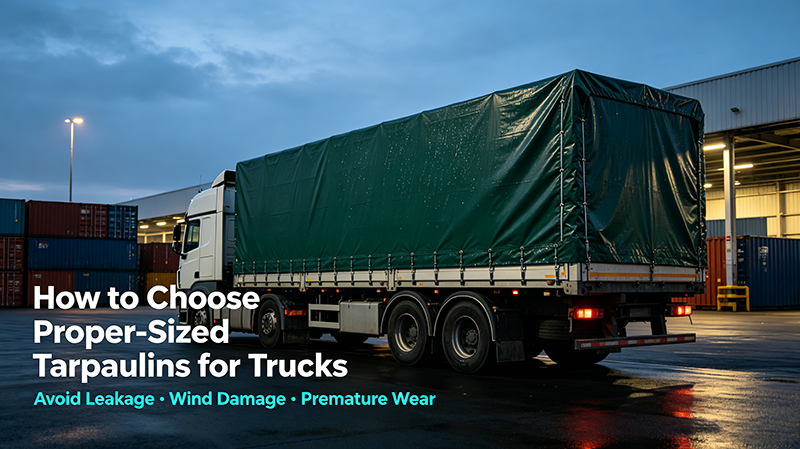
Poorly-fitted truck tarpaulins create frequent headaches for global road haulage businesses: spilled goods, rainwater intrusion, wind-induced fabric tearing, and higher fuel expenditure. As of 2026, precise sizing and standardized tarp selection have turned into baseline operational requirements for logistics fleets and freight operators across the globe. Well-defined sizing guidelines and targeted material specifications mitigate recurring transport issues, including partial cargo coverage, insecure fastening, and premature tarp deterioration on long-haul journeys.
Accurate dimension calculation according to truck model and loaded-cargo conditions forms the foundation of tarp fitting. For regular pickups fitted with 6-foot to 8-foot cargo beds, 10×12 ft or 12×15 ft tarps deliver the best performance, leaving adequate overhang for tie-down and fastening work. For flatbed trailers, 24×27 ft lumber tarps paired with 8-foot drop flaps serve as the mainstream option, covering nearly all conventional lumber and bulk-cargo shipments. When fitting dump trucks, follow this practical rule: select tarps 2–6 inches narrower than the carriage width, and add 2 ft extra length margin to guarantee full coverage and accommodate tilting discharge operations.
General-purpose fitting benchmarks are also available for reference. Allow 30–50 cm of extra tarp length past both ends of the cargo bed, and reserve 50–80 cm overlapping margin on each side in the width direction. Such sufficient overhang works as a practical safeguard against wind flutter and water infiltration at highway speeds. For long-distance routes and coastal areas exposed to strong gusts, add another 10–15 cm margin to boost overall installation stability. Regarding material options, lightweight HDPE woven tarps fit routine dry-goods transport scenarios. Heavy-duty PVC composite tarps, featuring outstanding tear strength, UV stability and waterproof traits, are the preferred solution for all-weather, long-haul heavy-load assignments.
Industry professionals point out that scientific sizing matching and application-oriented material picks can prolong tarp service life by roughly 30 percent and greatly lower potential transport safety risks. As global freight safety rules grow more rigorous, customized sizing and refined tarp selection will evolve into standard supporting hardware for compliant logistics operations.
Post time: Sep-01-2026


